The expedition’s hide-hauling wagon
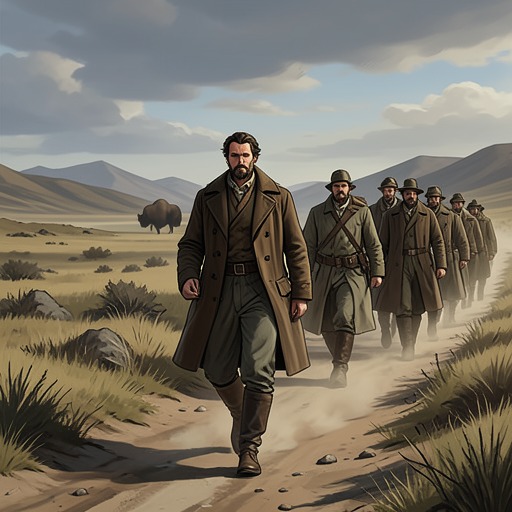
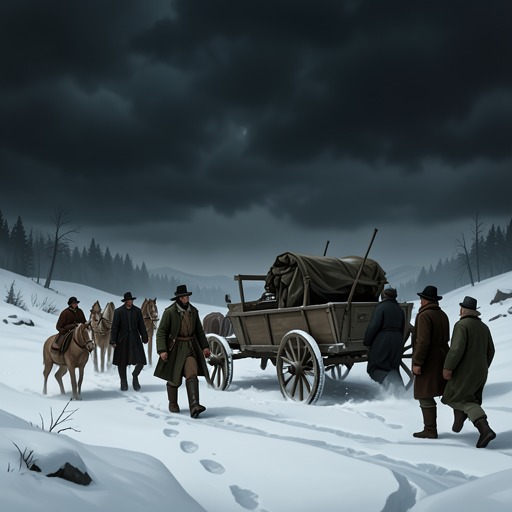
Butcher's CrossingThe expedition’s hide-hauling wagon turned the bison hunt into a transportable cargo, but it could not make that cargo secure: after surviving a winter exposed on the plains and a precarious descent from the mountain valley, it overturned in a river and lost its load. Its journey links the expedition’s labor to the trade that valued bison hides, while its destruction makes the gap between killing animals and realizing a profit brutally concrete.
Function in the Hide Trade
In Butcher’s Crossing, J.D. McDonald bought and processed bison hides, then sold them wholesale to Saint Louis; he described handling nearly one hundred thousand the previous year and expected two or three times as many that year. The trade depended on an extended chain: hunters killed and skinned the animals, buyers set a price, and wagons carried the heavy product toward a market. Before the expedition set out, Miller told the others that McDonald would buy their hides for four dollars apiece for winter pelts and already had an eastern buyer. That arrangement spared the hunters from hauling their cargo to Ellsworth, but it also made the expedition’s return transport a condition of turning its labor into money.
The wagon’s freight represented a changing landscape as well as a business opportunity. Miller remembered a time when the Kansas plains appeared black with bison and a two-week hunt could yield a thousand or fifteen hundred good spring hides. By the time of the expedition, hunters were fortunate to take two or three hundred in a trip, and Miller expected that within a year or two there would be no bison left to hunt in Kansas. He also recalled immense bone fields stretching from Pawnee Fork to the end of the Smoky Hill. The hide wagon carried the commercial residue of that depletion: an animal’s hide had a buyer and a price, while its bones and the carcass left behind could become waste or, at best, fertilizer.
Winter Exposure and Repair
After the blizzard, Miller, William Andrews, and Fred Schneider descended to the wagon, which had remained out on the open plain through the winter. Some of its lower boards had warped, and rust showed on the metal fittings. Miller judged that it could still do its work with a little grease. When he touched the metal band around a wheel, bright rust marked his finger; he wiped it on his dirt-stiffened trousers. The brief inspection gives the vehicle a material vulnerability distinct from the hunters’ confidence: it remained usable, but its capacity to carry the expedition home depended on worn wood, rusting fittings, and a repair Miller believed would suffice.
The wagon was not the only transport under strain. The horses had grown weak during the winter, and the returning hunters had to find oxen that had fled during the storm. After the horses recovered enough to be saddled, the men brought them down to the wagon. Their journey out would depend on the oxen’s strength, the wagon’s repairs, and the difficult terrain ahead; none of those elements offered much margin for error.
Loading and Mountain Descent
On the morning of departure, the party used its remaining coffee for a last-day celebration, then yoked the oxen and brought the wagon to the stacked hides. William Andrews, Fred Schneider, and Miller loaded the bundles while Charley Hoge cleared the camp and packed the smoked fish, meat, and other supplies into a large chest. Six enormous bales filled the wagon bed in pairs; six more went on top. Miller then made them add another six, despite Fred Schneider’s warning that the overloaded wagon would never make it down the mountain and could overturn at the first hole. The final stack rose ten or twelve feet above Charley Hoge’s seat and swayed over the sides. The load was not simply heavy: it was piled high enough to make balance a continuing danger.
They left the other packed hides in the valley, treating the bales with the remaining strychnine so that pests would not nest in them. The oxen strained into their yokes as Charley Hoge cracked his whip, and the wagon crept forward under the weight. Its freshly greased wheels sank deep into the soft ground, leaving parallel tracks through the yellow-green grass. At the pass, where snow still lay a handspan deep, Miller and Fred Schneider checked the large brake that would control the wagon on the descent.
The route down was slower and more precarious than the ascent. The hunters tied the horses together and let them follow while the men walked beside and behind the wagon. Its wheels tended to slide sideways whenever the track tilted. Miller found three pieces of rope in Charley Hoge’s tool basket and tied them over the load; the men held the ropes to keep the wagon from rolling as it shifted on the slope. At sharp turns, the bales swung so violently that the men were nearly lifted from the ground. They skidded forward on the smooth grass, braking with their heels and burning hands. Charley Hoge sat upright beneath the towering cargo, regulating its speed with alternating strokes of the whip and pulls on the brake. The weakened men and animals had to stop often to recover.
River Disaster and Lost Cargo
The wagon survived the descent but not the river crossing. A horse and a tree trunk struck its side almost together, pushing it against rocks as the load rocked and pulled at the vehicle. The rear of the convoy filled with water; then the wagon gave a sharp squeal and overturned. Charley Hoge got clear of the oxen as the overturned wagon’s weight dragged them back into the current. For a moment, the oxen’s weight kept the wagon partly steady, but the current pulled it across the rocky riverbed and turned it around. When the oxen lost their footing, the wagon swept downstream, striking larger rocks. Its harness broke, and the bison hides burst loose and were carried away. The men on shore watched the oxen struggle upside down against the current and the wrecked wagon spin downstream until it disappeared.
The loss was both physical and economic. Miller described a winter’s work disappearing in two minutes. Later, he insisted that three thousand winter hides remained in the mountains, worth more than ten thousand dollars even after transport costs, so the wrecked load was not the expedition’s only cache. But the river crossing had destroyed the wagon and the hides it carried, breaking the route by which the hunters expected to deliver their prize. Their achievement in the valley could not be separated from the practical problem of getting it out.
A Transport System Without a Market
The wagon’s failure came amid a wider collapse in the trade. When Miller later appealed to McDonald to honor the four-dollar price for winter hides, McDonald explained that demand had dried up: as with beaver pelts after beaver hats went out of fashion, customers had apparently bought the buffalo furs they wanted. He also described a new use for bison meat. Hunters were selling meat to the railroad company and leaving the hides to rot where they had skinned the animals; the railroad was being built fifty miles north. In that market, the wagon embodied an older commercial calculation, in which hides were valuable enough to justify the hunt and the arduous haul. Neither the vehicle nor the expedition’s labor could guarantee that distant buyers would still want the cargo. Its overturned frame and scattered hides thus mark more than a transport accident: they expose how fragile the chain was between ecological destruction, strenuous work, and a sale that might never happen.